
Black & White & Baby All Over
Learn why babies are drawn to black-and-white books and high-contrast toys, plus simple ways to use them for visual exploration, play, and connection.
Is your baby more fascinated by a ceiling fan than the expensive toy you carefully selected? No worries - your little love is right on track! Babies are fascinated by all sorts of patterns and movement as their vision develops.
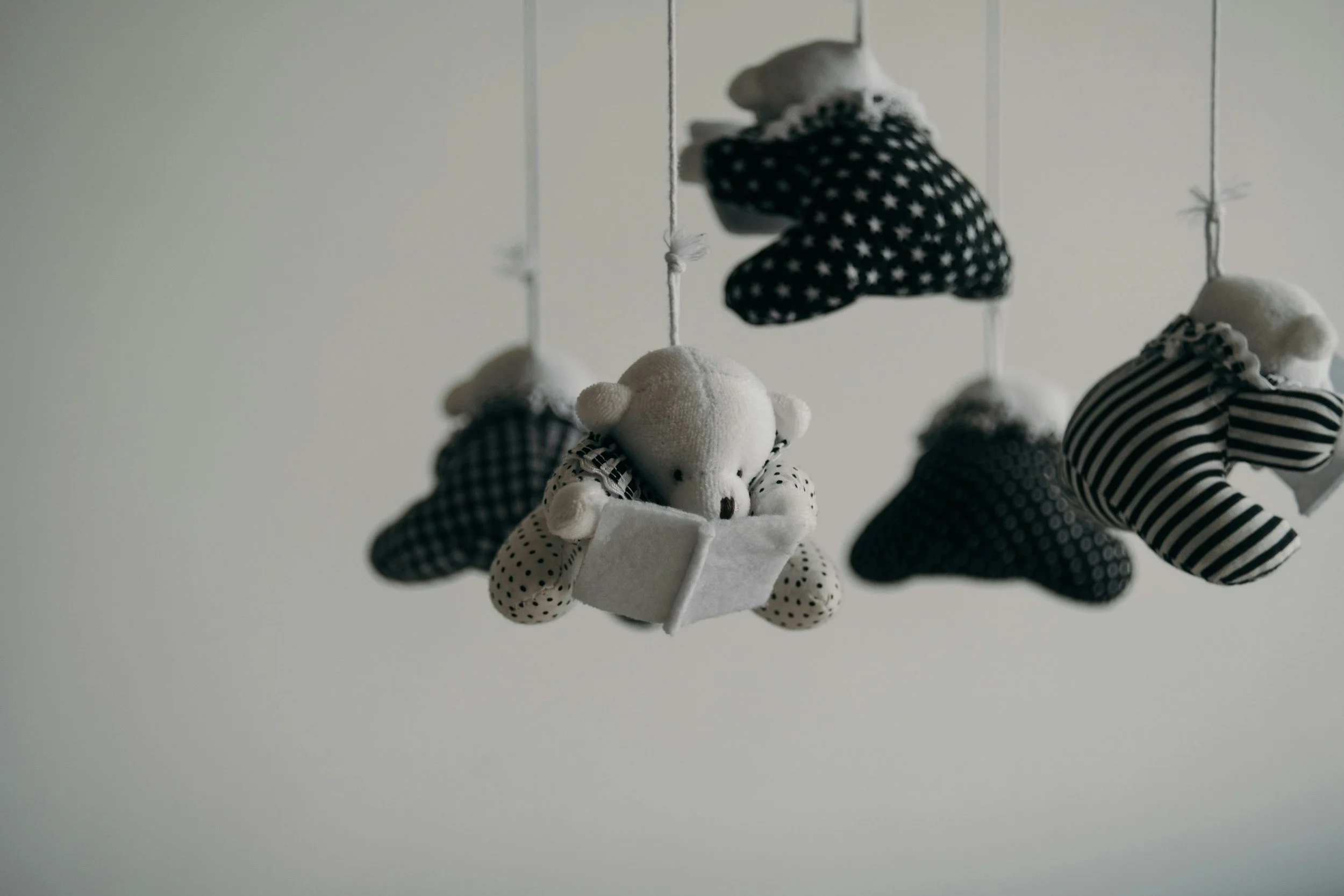
Newborns can see from birth, but their vision is still a work in progress. They see best at close range, and their ability to distinguish fine details and colors develops gradually during the first months of life. Bold patterns with strong contrast (like black and white stripes, circles, checks, and, yes, the ceiling fan) can stand out more clearly to a young baby's developing visual system.
High-contrast books and toys can give babies something interesting to look at, but the real magic happens when you get involved, too. Hold a black-and-white book while your baby looks at the pictures. Talk about what you see. Make up a completely unnecessary story about the random black circle. "Look at that! What do you think that is? A circle? A moon? The cookie you just watched me eat and not share with you?" Your baby doesn't care if your narration makes any sense. They're listening to your voice, watching your face, and experiencing the back-and-forth interaction that helps build the foundation for communication.
You may notice your baby staring intently at a pattern, turning toward an interesting image, following a picture with their eyes, or looking away when they've had enough. That last one is worth remembering. Babies are excellent at letting us know when they've reached their limit. If your little one looks away, gets fussy, or seems overwhelmed, it's time to take a break.
The fun part of high-contrast items is that you can introduce them right from the beginning. You don't need to wait for your baby to reach a particular milestone. During those early awake periods, you can offer a simple book, card, play mat, or toy and let your baby explore it at their own pace. Try holding a book or card about 8–12 inches from your baby's face—roughly the distance between you and your baby during a feeding or cuddle. And if they aren't interested? That's okay, too. Some days your baby will be fascinated by a black-and-white zebra. Other days, the ceiling fan will be the most exciting thing that has ever happened. Follow their lead.
There is no perfect toy, perfect book, or perfect way to play. A few simple, age-appropriate toys, a safe place to explore, and an engaged caregiver are more than enough to give your baby opportunities to learn and grow.
A Note on Baby Safety:
As you choose books and toys for your baby, look for items that are age-appropriate, sturdy, and free from small parts that could become choking hazards. Follow manufacturer recommendations and regularly check toys for loose pieces, damage, or wear. And remember: toys, books, pillows, and other objects should stay out of your baby's sleep space. Keep the crib or bassinet clear for sleep.
A Few of My Favorites:
There are a lot of baby products out there, and you certainly don't need all of them. But if you're looking for a few simple, high-contrast books and toys, I've included some products below that I like and would feel comfortable recommending to families. As always, if you have any questions, feel free to reach out to me directly!
(Some of these are associate links, which means I may receive a small commission if you purchase through a link, at no additional cost to you. As always, I only recommend products that I think are useful and appropriate for my families.)
Play Mat: https://amzn.to/4cD9mN8
Books: https://amzn.to/3Sbf9Tk
Toys: https://amzn.to/3RRTmA2
Toy Bar for Bouncer: https://amzn.to/3TRiMOQ